Best Hearing Aids for Seniors in Nigeria: Complete 2026 Guide
March 9, 2026 2026-09-12 4:38Best Hearing Aids for Seniors in Nigeria: Complete 2026 Guide
 Phantom Medicals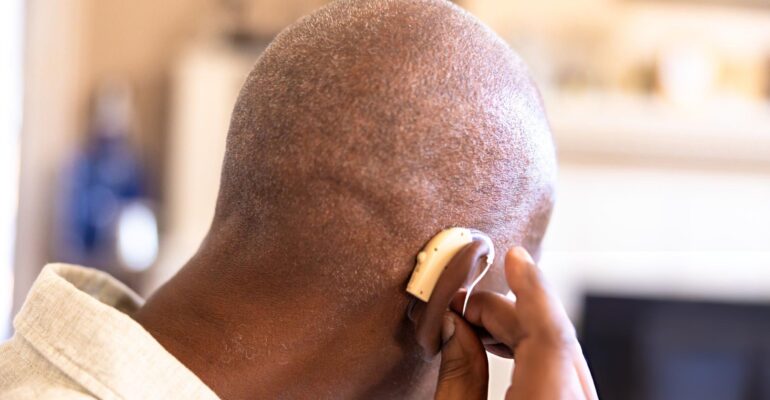
Best Hearing Aids for Seniors in Nigeria: Complete 2026 Guide
Last Updated: February 2026 | Reading Time: 10 minutes | Part of our Complete Hearing Aid Buying Guide for Nigeria
Introduction: Choosing for Parents, Not Just Products
Your father sits in the living room with the TV volume at maximum. Your mother asks people to repeat themselves constantly, then pretends she heard to avoid embarrassment. You’ve suggested a hearing aid three times. Each time: “I’m fine, my hearing is okay.”
Sound familiar?
If you’re reading this, you’re likely an adult child trying to help an elderly parent who needs hearing assistance but doesn’t know where to start — or won’t admit they need it. You’re not just choosing a device. You’re choosing something your 70-year-old mother with arthritis can operate independently, something your 65-year-old father won’t lose or break within a week, and something that actually works in Nigerian conditions.
This is different from buying a hearing aid for yourself. Seniors need specific features that younger users can overlook. They need simplicity over sophistication. Durability over discretion. Large controls over tiny invisible devices.
At Phantom Medical Supplies in Lagos, roughly 75% of our hearing aid customers are adult children buying for elderly parents. We’ve learned exactly what works, what fails, and what features matter most. This guide distills that experience into actionable advice.
If you haven’t read our types of hearing aids and how to choose guides, those provide essential background. But if you specifically need senior-focused guidance, keep reading.
Why Seniors Need Different Hearing Aids Than Younger Adults
Age creates specific challenges that directly affect hearing aid success:
Physical Dexterity Declines
Arthritis, reduced grip strength, and finger tremors make tiny controls and small batteries genuinely difficult. A 45-year-old can change a size 10 battery in 30 seconds. A 72-year-old with shaky hands struggles for 5 minutes and eventually gives up.
What this means: Larger devices with bigger batteries aren’t just easier — they’re the difference between independence and frustration.
Vision Deteriorates
Reading glasses help with books, but manipulating a tiny hearing aid volume wheel or inserting a minuscule battery still requires close-up precision vision many seniors simply don’t have anymore.
What this means: Controls must be large, clearly marked, and tactile (you can feel the difference by touch, not just sight).
Cognitive Load Tolerance Decreases
A 40-year-old can learn to switch between three program modes, adjust noise settings, and manage Bluetooth connections. An 80-year-old often wants: on, off, and maybe a volume wheel. Anything more complex gets ignored.
What this means: Simplicity beats features. One-program devices that work consistently outperform multi-program devices that confuse the user.
Maintenance Routine Challenges
Daily cleaning, proper storage in desiccant, weekly wax guard checks — these require executive function and memory. Many seniors struggle with consistent routines, especially if living alone.
What this means: The device must be forgiving of occasional missed maintenance, or you need to build family support for upkeep.
Technology Resistance
It’s not that seniors can’t learn technology. Many do successfully. But forcing someone who’s never used a smartphone to manage a Bluetooth-connected, app-controlled hearing aid is setting them up for failure.
What this means: Match technology complexity to the individual’s existing tech comfort level, not to what seems “modern.”
The 5 Most Important Features for Senior Hearing Aids
Forget Bluetooth. Forget smartphone apps. Forget 20 channels. Here’s what actually matters:
1. Large, Easy-to-Handle Controls
What to look for:
- Volume wheel at least 8mm in diameter (you can grip it with thumb and forefinger)
- Raised tactile markings (+ and – you can feel, not just see)
- On/off switch that clicks audibly (you know it’s actually off)
- Color-coded left/right indicators (red for right, blue for left is common)
Why it matters: Your parent needs to adjust volume independently while watching TV, not call you every time they need a change.
2. Large Battery Size (Size 13 or 675 for BTE)
What to look for:
- BTE devices using size 13 or 675 batteries (NOT size 10 or 312)
- Battery door that opens easily with a fingernail (not requiring precision tools)
- Color-coded battery positive side marking (makes insertion foolproof)
- 7–14 day battery life (weekly changes manageable, daily changes frustrating)
Why it matters: Battery changes are the #1 reason elderly users abandon hearing aids. Make it easy or it won’t happen.
3. Durable Construction
What to look for:
- Reinforced casing (drops happen — seniors drop things more often)
- Water-resistant coating (sweat, humidity, accidental exposure)
- Strong battery door hinge (the most common failure point on cheap devices)
- Replaceable parts readily available in Nigeria (ear domes, tubes, wax guards)
Why it matters: A device that breaks after 3 months causes frustration and financial loss. Durability matters more than discretion for seniors.
4. Strong Feedback Cancellation
What to look for:
- Digital feedback suppression (most digital models have this)
- Properly sized ear dome or mold (improper fit causes whistling)
- Automatic feedback detection that adjusts in real-time
Why it matters: Many seniors can’t hear high-frequency whistling but everyone around them can. This creates embarrassment and social withdrawal.
5. Simple On/Off, Minimal Programs
What to look for:
- Single program that works in most environments (not 3–5 programs to choose from)
- OR maximum 2 programs: indoor and outdoor (simple toggle)
- Clear on/off switch (not battery door as on/off — too confusing)
- Automatic shut-off after removal (prevents battery drain from forgetting to turn off)
Why it matters: Every additional control point is another thing to forget, another source of confusion. Simplicity drives consistent use.
Best Hearing Aid Types for Nigerian Seniors
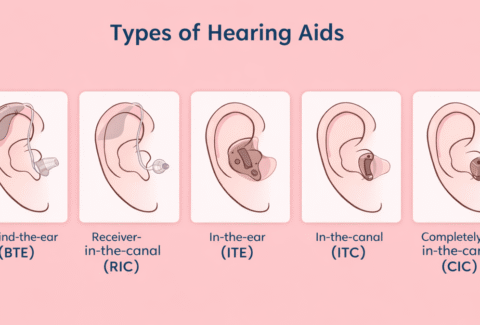
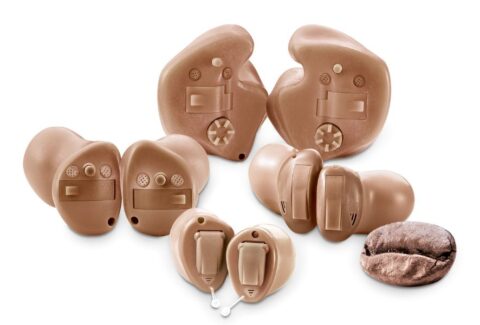
From our types guide, there are three main categories. Here’s which work best for elderly users:
BTE (Behind-The-Ear): Best for Most Seniors ⭐
Why BTE is ideal for seniors:
- Largest controls — easiest to operate with arthritic fingers
- Biggest batteries (size 13 or 675) — change weekly, not every 3 days
- Most durable — survives drops and handling better than smaller types
- Easy to locate if misplaced — not tiny like ITE/CIC
- Compatible with glasses — no interference
- Best for moderate to severe hearing loss (common in elderly)
Downsides: More visible. But honestly, most elderly users care more about hearing their grandchildren than about appearance.
Price range for quality senior-friendly BTE: ₦50,000–₦90,000
ITE (In-The-Ear): Good Compromise Option
When ITE works for seniors:
- Mild to moderate hearing loss only
- Senior has good dexterity (can handle size 10 or 312 batteries)
- Senior specifically wants something less visible
- Daily cleaning routine is manageable (family helps or senior is disciplined)
Best affordable ITE for seniors: The Axon K80 Mini at ₦25,000 works for many elderly users with mild-moderate loss who are reasonably independent with basic tasks. It uses size A10 batteries (smaller than ideal but manageable) and has a simple volume dial.
Important caveat: ITE requires more maintenance than BTE in Nigerian humidity. If your parent struggles with daily routines, go BTE instead.
CIC (Completely-In-Canal): Generally Not Recommended for Seniors
Why we don’t recommend CIC for most elderly users:
- Tiny size 10 batteries require precision dexterity
- Difficult to insert and remove (requires good coordination)
- Easy to lose (genuinely invisible means genuinely hard to find when dropped)
- Insufficient power for moderate-severe loss (common in seniors)
- Higher maintenance requirements
- Significantly more expensive with no practical benefit for elderly users
Exception: Younger seniors (60–70) with excellent dexterity, mild loss only, and strong preference for invisible devices. But this is maybe 10% of elderly buyers.
Recommendation hierarchy for seniors:
1st choice: BTE with large batteries
2nd choice: ITE if dexterity is good and loss is mild-moderate
3rd choice: CIC only in rare cases where senior specifically insists and can demonstrate ability to handle it
Our Top 5 Recommendations for Nigerian Seniors (2026)
Based on price, availability in Lagos, senior-friendly features, and customer feedback:
Best Overall Value: Digital BTE (₦55,000–₦75,000 Range)
What to look for: 4–8 channel digital BTE, size 13 battery, simple volume wheel, single program or basic 2-program toggle, feedback cancellation included.
Best for: Moderate hearing loss, active seniors who move between home and outdoor environments, budget-conscious families seeking long-term reliability.
Where to buy: Medical equipment stores in Ikeja, Marina, Yaba. Ask specifically for “senior-friendly BTE with large controls.”
Expected lifespan: 3–4 years with proper care.
Best Budget Option: Entry ITE (₦25,000–₦35,000 Range)
Specific recommendation: Axon K80 Mini at ₦25,000 from Phantom Medical Supplies.
Best for: Mild hearing loss, primarily indoor use (watching TV, family conversations at home), seniors with reasonably good dexterity, tight family budget.
Realistic expectations: This won’t outperform ₦70,000 BTE in noisy environments. But for grandparents who mostly stay home and want to hear the TV and grandchildren clearly, it works. We’ve sold it to hundreds of families with good satisfaction when matched to the right use case.
Important: Requires daily cleaning and proper storage. If your parent can’t maintain daily routine, spend more for BTE instead.
Best for Severe Hearing Loss: Power BTE (₦80,000–₦120,000 Range)
What to look for: 8–12 channels, high-power amplification, size 675 battery (longest life), strong feedback cancellation, directional microphones.
Best for: Severe hearing loss (can barely hear even in quiet rooms), seniors who’ve avoided hearing aids for years and now need significant help, users who failed with weaker devices.
Where to buy: Audiology clinics in Lagos/Abuja, or reputable medical equipment stores that can verify the amplification power specs.
Professional fitting recommended: At this severity level, proper fitting genuinely improves outcomes. Budget extra ₦10,000–₦20,000 for professional programming.
Best for Active Outdoor Seniors: Rugged BTE (₦60,000–₦85,000 Range)
What to look for: Water-resistant coating, reinforced casing, dust protection, strong noise reduction (essential for Lagos traffic and markets), size 13 battery.
Best for: Retired seniors who still work (small shop owners, market vendors, tradespeople), very active grandparents involved in outdoor activities, seniors living in areas with high dust/heat exposure.
Key feature: Durability over refinement. These won’t be the sleekest devices, but they survive Nigerian conditions better than delicate models.
Easiest to Use: Single-Program BTE with Auto-On (₦65,000–₦80,000 Range)
What to look for: Automatic on/off when inserted/removed (no buttons to remember), single program (no mode switching), large volume wheel, clear battery polarity marking.
Best for: Seniors with early dementia or memory issues, users who repeatedly forget to turn devices on/off, elderly living alone who need maximum simplicity.
Special benefit: Reduces daily decision points to nearly zero. Insert device → it works. Remove device → it turns off automatically. Volume adjustment is the only control needed.
What to Avoid When Buying for Seniors
Common mistakes we see repeatedly:
❌ Don’t Buy the Smallest/Most Invisible Option
Your mother doesn’t need invisible. She needs functional. CIC might look good to you, but if she can’t change the battery or loses it twice a week, it’s useless regardless of how discreet it is.
❌ Don’t Prioritize Bluetooth and App Control
If your parent doesn’t use a smartphone confidently, Bluetooth hearing aids just add complexity they’ll never use. Save ₦30,000–₦50,000 and buy simpler.
❌ Don’t Assume “Premium” Means “Better for Seniors”
A ₦180,000 premium hearing aid with 20 channels and 5 programs might be objectively superior technology. But if it confuses your 78-year-old father and he stops wearing it, a ₦60,000 simple BTE that he actually uses is infinitely better.
❌ Don’t Buy Online Without In-Person Testing
Seniors need to physically handle the device before purchase. Can they open the battery door? Can they feel the volume wheel? Can they insert it in their ear? These questions can’t be answered from a Jumia product photo.
❌ Don’t Ignore Your Parent’s Input
If your parent says “this feels too complicated” during testing, believe them. Their assessment of their own capabilities is usually more accurate than your optimistic hopes. Start simpler, upgrade later if needed.
❌ Don’t Skip the Adjustment Period Discussion
Elderly users often expect instant perfection. Explain upfront: the first 2 weeks will feel weird. Sounds will be too loud. Their own voice will sound strange. This is normal brain adjustment, not device failure. Manage expectations or they’ll give up too quickly.
How to Actually Get Your Parent to Use the Hearing Aid
Buying the device is only half the battle. Getting consistent use requires strategy:
Step 1: Frame It Positively, Not Medically
Don’t say: “Your hearing is bad, you need this device.”
Do say: “This will help you enjoy conversations with your grandchildren more clearly.”
Focus on what they gain (connection, enjoyment, participation) not what they’ve lost (hearing ability).
Step 2: Involve Them in the Decision
Take them to the store. Let them see options. Let them express preferences. Adult children who surprise elderly parents with hearing aids they never requested often end up with unopened boxes.
Step 3: Practice Together Initially
First week, sit with them daily:
- Show them how to insert properly
- Practice battery changes together
- Demonstrate cleaning routine
- Adjust volume to comfortable level
- Troubleshoot any feedback whistling
After 7–10 days of supported use, most seniors become independent with the routine.
Step 4: Start with Short Usage Periods
Week 1: 2–3 hours daily (during favorite TV show or family meal)
Week 2: 4–6 hours daily
Week 3: Full waking hours
Gradual adaptation prevents overwhelm and increases long-term compliance.
Step 5: Address Complaints Seriously
If they say “everything is too loud,” don’t dismiss it. Reduce volume. If they say “it whistles,” check the fit. Validating their concerns and troubleshooting builds trust and continued use.
Step 6: Build Maintenance into Existing Routine
Link hearing aid care to something they already do religiously:
- “Clean your hearing aid when you brush your teeth before bed”
- “Put it in the desiccant jar when you take your evening medication”
- “Change the battery every Sunday after church”
Attaching new habits to existing routines dramatically improves compliance.
Special Considerations for Nigerian Seniors
Power Outages and Rechargeable Batteries
Rechargeable hearing aids sound convenient but require 4–6 hours of charging time. With unpredictable NEPA power supply in most Nigerian homes, this creates problems.
Recommendation: Stick with replaceable batteries for Nigerian seniors unless the household has reliable inverter/generator backup.
Heat and Humidity Effects
Elderly users may not remember daily desiccant storage. Choose devices known for better humidity resistance (BTE over ITE), and set up family reminders if the senior lives alone.
Medical Store Access
If your parent lives in areas outside Lagos/Abuja, battery availability becomes critical. Verify before purchase that the battery type is available at local pharmacies in their specific area.
Language and Instruction Materials
Most hearing aid manuals are in English. If your parent is more comfortable in Yoruba, Igbo, or Hausa, you’ll need to translate and simplify instructions into their preferred language. Create a one-page pictorial guide they can reference.
Cultural Resistance to “Old Age Devices”
Some elderly Nigerians resist hearing aids because they see them as admitting weakness or old age. Frame the device as a tool for continued independence and participation in family life, not a medical disability marker.
Success story approach: “Pastor at church uses one” or “Your friend Mrs. Adeyemi has one and loves it” often works better than clinical medical arguments.
Frequently Asked Questions
What is the best hearing aid for a 70-year-old in Nigeria?
For most 70-year-olds: a digital BTE with 4–8 channels, size 13 battery, simple volume control, and single-program operation in the ₦55,000–₦75,000 range. This balances affordability, ease of use, and sufficient power for typical age-related hearing loss. If budget is tight, the Axon K80 Mini ITE at ₦25,000 works for mild loss and good dexterity.
Should I buy BTE or ITE for my elderly parent?
BTE is safer for most elderly users because: larger batteries, easier to handle, more durable, better for moderate-severe loss (common in seniors). Choose ITE only if your parent has mild loss, good dexterity, and specifically prefers something less visible. When in doubt, go BTE. Read our types comparison for full details.
Can a 75-year-old manage a hearing aid on their own?
Yes, if you choose the right device. BTE with size 13 or 675 batteries, large controls, and simple on/off operation can be managed independently by most 75-year-olds. Avoid tiny batteries, complex programs, and app-controlled devices unless your parent specifically demonstrates ability to handle them during testing.
How do I convince my parent they need a hearing aid?
Don’t focus on their hearing loss. Focus on what they’re missing: grandchildren’s voices, conversations at family gatherings, TV shows they enjoy. Suggest trying a device for 2 weeks with return option. Often experiencing the benefit convinces them better than arguments. Consider getting a professional hearing test first — audiologist recommendations carry more weight than family pressure.
What’s a reasonable budget for a senior’s hearing aid in Nigeria?
₦25,000–₦90,000 covers most senior needs effectively. Below ₦20,000 is risky (poor quality). ₦50,000–₦75,000 is the sweet spot (reliable digital with senior-friendly features). Above ₦100,000 is overkill unless severe hearing loss requires it. See our complete price guide for details.
My parent keeps losing their hearing aid. What should I do?
Switch to BTE instead of ITE/CIC — larger size makes it harder to misplace. Establish a designated storage location (bright-colored case on bedside table). Consider a lanyard attachment (available for most BTE models) so it can hang around their neck when not in ear. Some families resort to “hearing aid goes in the Bible” or other prominent object the senior uses daily — unconventional but it works.
Can seniors with arthritis change hearing aid batteries?
Yes, if you choose size 13 or 675 batteries with easy-open battery doors. Size 10 and 312 batteries are too small for most seniors with arthritis. Some BTE models now include battery door openers built into the casing specifically for this issue. Test battery changes in the store before buying — if your parent can’t do it in the store, they won’t do it at home.
Should I buy two hearing aids or just one?
If both ears have hearing loss (most common), two devices provide better sound localization and balance. But cost doubles. Many Nigerian families start with one device for the worse ear, see if parent adapts successfully, then add the second device later. This works as a practical budget approach. Ideally, two is better. Practically, one used consistently beats two sitting in a drawer.
Where can I get professional help fitting a hearing aid for my parent in Lagos?
Audiology clinics at teaching hospitals (LUTH, LASUTH), private audiology clinics in Victoria Island and Lekki, and some medical equipment stores offer professional fitting services (₦10,000–₦30,000). For basic devices, store-provided guidance often suffices. For severe loss or complex cases, professional fitting improves outcomes. Call 08132719143 for Phantom Medical Supplies guidance on whether your parent’s case needs professional fitting.
Conclusion: Choose With Your Parent’s Reality in Mind
The best hearing aid for a Nigerian senior isn’t the most advanced, the most expensive, or the most invisible. It’s the one they’ll actually use consistently.
Key takeaways:
- Prioritize ease of use over features — large controls, big batteries, simple operation
- BTE wins for most seniors — durability and handleability matter more than discretion
- Match the device to their actual dexterity, vision, and tech comfort level
- Budget ₦50,000–₦75,000 for quality digital BTE that balances value and capability
- Involve your parent in the decision — devices chosen together get used more consistently
- Plan for 2-week adjustment period with daily support initially
- Test before buying — 10 minutes in-store prevents months of frustration
Your action plan:
- Assess your parent’s hearing loss severity (professional test recommended — Lagos testing options)
- Evaluate their dexterity, vision, and tech comfort honestly
- Review our choosing framework with senior-specific considerations in mind
- Take them to test devices physically — Phantom Medical Supplies in Lagos welcomes families for hands-on testing
- Start with simpler option if uncertain — upgrade later if needed
- Support them through the first 2 weeks of adaptation
- Build maintenance into daily routine
If your parent has mild-moderate hearing loss, good dexterity, and primarily needs help with indoor conversations and TV, the Axon K80 Mini at ₦25,000 is a solid starting point. If they have moderate-severe loss, reduced dexterity, or active outdoor lifestyle, invest in a senior-friendly BTE in the ₦55,000–₦75,000 range.
Call 08132719143 or visit phantommedicalsupplies.store to discuss your parent’s specific situation. Bring them to our Lagos location for hands-on testing. We’ll help you find what actually works for their reality — not just what sounds good on paper.
Your parent deserves to hear clearly. Choose wisely. Choose today.
Related Articles
- Complete Guide to Buying Hearing Aids in Nigeria (2026)
- Types of Hearing Aids Explained: BTE, ITE & CIC
- How to Choose the Right Hearing Aid
- Hearing Aid Prices in Nigeria 2026: Complete Cost Breakdown
- Where to Get a Hearing Test in Lagos
- Hearing Aid Maintenance for Nigeria’s Climate
- Axon K80 Mini — Product Details & Price
Author: Phantom Medical Supplies team, Lagos. Based on experience serving over 400 elderly Nigerian customers and their families. Information accurate as of February 2026. For personalized senior-specific guidance, call 08132719143 or visit phantommedicalsupplies.store.
Medical Disclaimer: This guide is for informational purposes. For severe hearing loss, sudden hearing changes, ear pain, or other medical concerns, consult an ENT doctor or audiologist before purchasing any device.