
Types of Hearing Aids in Nigeria: BTE, ITE & CIC Explained
February 17, 2026 2026-03-09 16:43Types of Hearing Aids in Nigeria: BTE, ITE & CIC Explained
 webmaster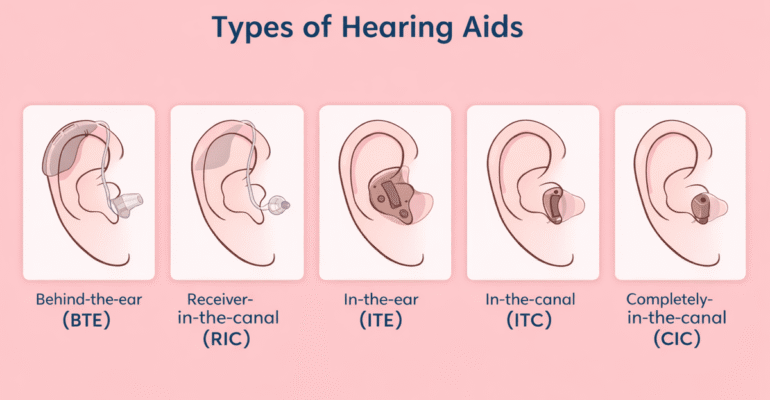
Types of Hearing Aids in Nigeria: BTE, ITE & CIC Explained
Last Updated: February 2026 | Reading Time: 9 minutes | Part of our Complete Hearing Aid Buying Guide for Nigeria
Introduction
Picture this: You walk into a medical equipment store somewhere along Ikorodu Road in Lagos. The seller places three different hearing aids on the counter. One sits behind the ear. One fits inside it. The third is so tiny you almost miss it. He’s talking fast, using terms you’ve never heard, and your elderly father — who’s the one who actually needs the device — is sitting quietly beside you, already overwhelmed.
Sound familiar? This is how most Nigerians first encounter the world of hearing aids. Nobody explains what the differences actually mean for day-to-day life in Nigeria’s heat, dust, and noise. That’s exactly what this guide does.
We’ll break down the three main types of hearing aids — BTE, ITE, and CIC — in plain language, with honest pros, cons, prices in Naira, and real Nigerian scenarios for each. If you haven’t read our complete hearing aid buying guide yet, that’s a good starting point. But if you already know you need a hearing aid and just want to understand the types before committing, you’re in the right place.
The 3 Main Types of Hearing Aids
Every hearing aid sold in Nigeria — regardless of brand, price, or where you bought it — falls into one of three categories based on where it sits on or in your ear:
- BTE (Behind-The-Ear): Sits behind the ear, connected to an earpiece by a thin tube or wire
- ITE (In-The-Ear): Fits directly inside the outer bowl of your ear
- CIC/IIC (Completely-In-Canal / Invisible-In-Canal): Sits deep inside your ear canal, largely hidden from view
That’s it. Three categories. Everything else — brand names, “digital” labels, fancy packaging — is secondary to this foundational choice. Let’s go through each one properly.
Behind-The-Ear (BTE) Hearing Aids: Everything You Need to Know
How BTE Works
A BTE hearing aid is a small plastic device that hooks over the top of your ear and sits snugly behind it. Inside that casing: a microphone, amplifier, and battery. A thin tube or wire runs from the device, curving into your ear canal where a soft earpiece (called an ear dome) delivers the amplified sound.
The mechanics are simple and reliable — which is exactly why BTE has been the most common hearing aid type globally for decades.
Who BTE Is Best For
BTE is the right choice if you have moderate to severe hearing loss, or if you’re buying for an elderly parent who needs something easy to handle. The controls are larger, the battery is bigger, and the whole device is far more manageable than the smaller options. If your parent has arthritis, reduced grip strength, or eyesight that’s not what it used to be — BTE wins every time.
BTE Advantages in Nigerian Climate
Here’s something most sellers won’t tell you: the Nigerian climate is genuinely harsh on hearing aids. Lagos humidity sits above 80% for much of the year. Add the dust from unpaved roads, generator fumes, and market environments — and you quickly understand why device durability matters.
BTE handles these conditions better than its smaller counterparts because:
- The electronics sit behind the ear, away from earwax buildup
- The casing is larger and more robust — less prone to moisture damage
- The ear dome is replaceable cheaply when it wears out
- Battery compartments are easier to dry out after sweaty days
For market traders in Oshodi, okada riders, or anyone spending long hours in the heat — BTE is genuinely the more practical choice.
BTE Disadvantages
Visibility is the main complaint. BTE hearing aids are harder to conceal, especially on people with shorter hair. They can also interfere with glasses — the arm of your glasses and the hearing aid housing will compete for the same real estate behind your ear. Wind noise is occasionally an issue outdoors, though most modern BTE models manage this reasonably well.
BTE Price Range in Nigeria
₦45,000 – ₦250,000 depending on technology level (analog vs. digital), brand, and whether professional fitting is included. Basic battery-operated BTE models that work well for daily use typically fall in the ₦50,000 – ₦90,000 range.
In-The-Ear (ITE) Hearing Aids: The Discreet Choice
How ITE Works
ITE hearing aids are custom or semi-custom shells that fit entirely within the outer bowl of your ear. All the components — microphone, amplifier, battery compartment, volume control — live inside that single unit. Nothing sits behind your ear. Nothing connects by a wire to an external device. It’s a self-contained system inside your ear.
Who ITE Is Best For
People with mild to moderate hearing loss who want something less visible than BTE but still practical to handle. ITE strikes a workable balance — it’s discreet enough that most people won’t immediately notice it, but the controls and battery are still accessible enough for older adults to manage independently.
It’s also a good fit for people who wear glasses regularly. Unlike BTE, there’s nothing behind the ear competing with your glasses arm.
ITE in Nigeria’s Heat and Humidity
This is where honest advice matters. Because ITE sits inside your ear, it’s exposed to earwax and moisture more directly than BTE. In a country where heat and humidity are a daily reality, this means:
- You need to clean it more consistently — ideally every evening
- A desiccant drying kit (silica gel jar) is not optional, it’s essential
- Wax guards need checking and replacing regularly
- Storage matters — never leave it sitting in a hot car or near a window
None of these are dealbreakers. They’re just the real maintenance reality in Nigeria’s climate, and any seller who doesn’t mention them is doing you a disservice.
ITE Advantages and Disadvantages
Advantages: More discreet than BTE. No external wire or tube. Compatible with glasses. Good for mild-moderate hearing loss. Typically easier to put on and remove than CIC models. Volume control usually accessible with a fingertip.
Disadvantages: More vulnerable to earwax and moisture than BTE. Battery life slightly shorter (though still perfectly usable). Not powerful enough for severe to profound hearing loss. Requires more frequent cleaning.
ITE Price Range in Nigeria
₦25,000 – ₦120,000. This is the widest price spread of the three types, because it includes everything from basic analog ITE devices to decent digital models with noise reduction.
One well-regarded option in this range is the Axon K80 Mini — a popular ITE in Nigeria priced at ₦25,000. It’s battery-operated (standard A10 cell, widely available in Lagos), skin-tone in design, and comes with multiple ear tip sizes so you can find a comfortable fit at home without professional fitting. It’s not a premium device — it won’t outperform a ₦90,000 digital model — but for mild-to-moderate hearing loss in a relatively quiet or indoor environment, it does the job honestly.
Completely-In-Canal (CIC) and Invisible-In-Canal (IIC): The Invisible Option
How CIC/IIC Works
CIC and IIC hearing aids sit deep inside your ear canal — far enough in that most people looking at you won’t see anything. IIC goes even deeper, earning the “invisible” label more genuinely. All the electronics are miniaturized into a tiny shell that’s either custom-moulded to your canal or comes in a near-universal small size.
Who It’s Really For
Younger adults (30s to early 50s) with mild hearing loss who work in professional or social environments where appearance matters to them. People who are already active hearing aid users upgrading from a visible model. Anyone with very mild high-frequency loss who primarily struggles with understanding speech in quiet settings.
Why It’s NOT Always the Best Choice
Let’s be direct here, because many sellers push CIC hard because the margins are better.
CIC is genuinely impractical for a large portion of Nigerian buyers for these reasons:
- Tiny battery. Size 10 batteries last 3-5 days and require very precise fingers to change. For elderly users or anyone with reduced dexterity, this becomes a recurring frustration.
- Not powerful enough. If your hearing loss is moderate to severe — which describes most older Nigerians seeking help — CIC simply won’t amplify enough.
- Earwax is more of an enemy. Sitting deep in the canal means earwax clogs the device faster. In Nigeria’s heat, where earwax production increases, this means more repairs and more frustration.
- More expensive, harder to repair locally. If something goes wrong with a CIC in Lagos, finding someone to service it correctly is significantly harder than with a BTE or ITE.
Availability Challenges in Nigeria
Good quality CIC models are genuinely hard to find through legitimate channels in Nigeria. What you’ll commonly see on Jumia or in smaller medical stores labelled “invisible hearing aids” are often poor-quality analog devices that whistle constantly and stop working within weeks. Custom-moulded CICs from reputable brands require audiologist fittings that are only available in a handful of clinics in Lagos and Abuja.
CIC Price Range in Nigeria
₦80,000 – ₦200,000 for legitimate models. Be very wary of anything marketed as CIC or “invisible” below ₦40,000 — the quality is almost always poor.
Side-by-Side Comparison: BTE vs. ITE vs. CIC in Nigeria
| Feature | BTE | ITE — Axon K80 Mini ⭐ | CIC / IIC |
|---|---|---|---|
| Visibility | Visible — sits behind ear | Nearly discreet — skin-tone, in-ear | Near invisible (if quality is good) |
| Hearing loss severity | Mild to profound | Mild to moderate ✓ | Mild only |
| Battery life | 7–14 days (A13/A675) | 3–5 days (A10) — standard size | 3–5 days (Size 10) — very small |
| Ease of handling | Easiest — large controls | Moderate — manageable for most | Difficult — tiny, requires precision |
| Humidity/dust resistance | Best — electronics behind ear | Good with proper daily care | Most vulnerable — deep in canal |
| Price range (Nigeria) | ₦45,000 – ₦250,000 | From ₦25,000 | ₦80,000 – ₦200,000+ |
| Availability in Nigeria | Widely available | Widely available ✓ | Limited — quality options rare |
| Best for | Active seniors, severe loss, outdoor use | Office workers, mild–moderate loss, value seekers | Younger users, mild loss, appearance priority |
⭐ ITE column highlights the Axon K80 Mini as a reference point. For a full breakdown of prices across all types and brands, see our Hearing Aid Price Guide for Nigeria 2026.
Which Hearing Aid Type Is Right for Most Nigerians?
We’re going to give you a straight answer here — no “it depends” hedging that leaves you more confused than before.
Profile A: The Active Senior or Outdoor Worker
You spend long hours outdoors. Maybe you’re a retired civil servant who now runs a small shop in the market, or your father repairs generators in his compound all day. Humidity, dust, and physical activity are daily realities.
Get a BTE. The durability advantage is real and practical. You don’t want to be fiddling with a tiny device after a long hot day. The visibility concern matters far less than having something that actually keeps working. Look in the ₦50,000–₦90,000 range for a decent digital BTE.
Profile B: The Office Professional or Home User
You work in an air-conditioned office, spend time at home with family, or attend church and social gatherings. Noise levels are manageable, and you want something that doesn’t draw attention at meetings or during conversations.
ITE is your fit. The discretion is real without the impracticality of CIC. An ITE like the Axon K80 Mini at ₦25,000 is a genuinely sensible starting point if your loss is mild to moderate — it handles the environments you’re actually in, and the maintenance routine is manageable once you build the habit.
Profile C: The Fashion-Conscious Buyer or Younger Adult
You’re in your 40s or early 50s, mildly hard of hearing, and the idea of anyone seeing a hearing aid genuinely bothers you. CIC appeals for obvious reasons.
Our honest take: If you’re committed to CIC, go to a proper audiology clinic in Lagos or Abuja — not a random online seller — and get a professional fitting. Budget at least ₦100,000 for a model worth buying. Don’t cut corners here. A cheap CIC is worse than no hearing aid at all because it creates an awful first impression of the entire category.
And seriously consider ITE first. The Axon K80 Mini’s skin-tone design is far less visible in everyday life than most people imagine before trying it.
4 Things to Check Before Choosing Your Hearing Aid Type
Before you decide, run through this quickly:
- Hearing loss severity: Mild? Any type works. Moderate? BTE or ITE. Severe? BTE only. Don’t know? Get a hearing test in Lagos first — it changes everything.
- Dexterity and finger strength: Arthritic fingers or shaky hands? Go BTE. Eliminate CIC from consideration entirely.
- Daily environment: Market, outdoor site, or active lifestyle? BTE. Office, home, or church setting? ITE works well. Both types need regular maintenance appropriate to Nigeria’s climate.
- Budget: Under ₦30,000? ITE is your realistic entry point. ₦50,000–₦90,000? You have real options in both BTE and ITE. Above ₦100,000? All three types open up with better quality models. See our best options for seniors for age-specific recommendations.
Frequently Asked Questions
Which type of hearing aid is most popular in Nigeria?
BTE is the most widely available type across Nigeria — you’ll find it in medical stores from Lagos Island to Kano to Enugu. ITE is gaining popularity, particularly in Lagos, as more buyers prioritise discretion. CIC in quality versions is still relatively rare outside specialist clinics in Lagos and Abuja.
Is BTE or ITE better for old age?
For most elderly Nigerians, BTE is the safer recommendation. The battery is larger (easier to handle), the controls are more accessible, and the device itself is more durable with daily use. ITE works well for active older adults who are comfortable managing smaller components and committed to a daily cleaning routine.
What’s the cheapest hearing aid type available in Nigeria?
ITE devices offer the lowest entry point for functional hearing aids. The Axon K80 Mini starts at ₦25,000 from Phantom Medical Supplies — that’s a legitimate, functional ITE with adjustable volume and multiple ear tip sizes included. For context, the cheapest functional BTE options start around ₦45,000. CIC models below ₦80,000 in Nigeria are generally not worth buying. Call us on 08132719143 if you want to discuss which fits your budget.
Can I wear an ITE hearing aid with glasses?
Yes — ITE actually pairs better with glasses than BTE does. Because there’s nothing sitting behind the ear, there’s no conflict with your glasses arm. This is one of the practical reasons many glasses-wearers specifically ask for ITE models.
Which hearing aid type needs the least maintenance?
BTE requires the least day-to-day maintenance because the main electronics sit away from the ear canal, protected from earwax and moisture. CIC requires the most maintenance — it sits deepest in the canal and is most exposed. ITE sits in the middle. All three types require regular cleaning, especially in Nigeria’s humid environment.
Do all types work for severe hearing loss?
No. Only BTE provides sufficient amplification for severe to profound hearing loss. ITE handles mild to moderate loss well. CIC is suitable for mild loss only. If you or your parent has significant difficulty hearing even in quiet rooms, BTE is the only practical choice.
How do I know which type I need without seeing a doctor?
Use this rough self-assessment: If you miss words regularly in quiet conversations, that’s likely mild to moderate loss — ITE or BTE works. If you struggle to hear even when someone is speaking directly to you at close range, that suggests moderate to severe — go BTE. If you can hear but words often seem unclear or muffled, that’s typically mild — any type may help. That said, a proper hearing test in Lagos gives you actual data rather than guesswork, and most are quick and affordable. We strongly recommend one before investing ₦50,000 or more in a device.
Conclusion: Know Your Type, Make a Confident Choice
Three types. Three very different real-world experiences. BTE for durability and power. ITE for discretion and value. CIC for near-invisibility — with caveats that matter in the Nigerian context.
Most Nigerians buying a first hearing aid will be best served by either a BTE or ITE model. Your next step is figuring out exactly which one fits your specific situation — and our guide on how to choose the right hearing aid walks through that decision with a step-by-step framework.
If you’ve read this and already know ITE is the right direction for you, the Axon K80 Mini at ₦25,000 is available now at Phantom Medical Supplies. It won’t outperform a premium model, but it’s an honest, functional device at an honest price. Get yours from Phantom Medical Supplies — or call 08132719143 to speak with someone who’ll point you in the right direction, not just make a sale.
Related Articles
- Complete Guide to Buying Hearing Aids in Nigeria (2026)
- How to Choose the Right Hearing Aid for Your Needs
- Hearing Aid Prices in Nigeria 2026: Full Breakdown
- Best Hearing Aids for Seniors in Nigeria
- Hearing Aid Maintenance Guide for Nigeria’s Climate
- Axon K80 Mini — View Product & Price
Author: Phantom Medical Supplies team, Lagos. Based on 3 years of direct experience supplying and supporting hearing aid users across Nigeria. Information accurate as of February 2026. For personalised advice, call 08132719143 or visit phantommedicalsupplies.store.
Medical Disclaimer: This article is for informational purposes only. For severe hearing loss or any ear-related medical concern, please consult a qualified audiologist or ENT doctor.